

On this page
- What actually changes when the clinic has wheels
- How to start a mobile IV therapy business: the order that works
- Where the states name mobile services specifically
- Mixing the bag in someone’s home
- The vehicle: a mobile IV van, or the car you already own
- Sharps and waste when there is no back room
- Emergencies in a living room
- Mobile IV insurance
- What a mobile IV business costs to start
- A mobile IV franchise, or your own name
- What tends to go wrong
- The business question underneath
- Where we sit
A mobile IV business is cheaper to start than a clinic and no easier to run lawfully. The ownership rules, the prescriber’s order and the exam are the same as for a storefront. What changes is everything the building used to do for you: storage, a clean surface, waste, privacy and help when a client reacts badly.
What actually changes when the clinic has wheels
We have covered who can own an IV business, who has to write the order and where the bags come from in Starting an IV hydration business. None of that relaxes for a mobile service, and this article does not repeat it.
Whether you call it a mobile IV hydration business, a mobile IV infusion business or a concierge service, what a mobile operator takes on is narrower and more practical. A treatment room is a controlled place: it has a fridge at a known temperature, a counter that gets wiped down, a sharps bin on the wall, a second person within earshot and an address a regulator can visit. Going mobile removes all five and leaves the obligations they were meeting. So the work of starting a mobile IV business is mostly the work of replacing a room with written procedures and equipment that travels.
Three questions organise the rest:
- Does your state treat a mobile service differently from a fixed one? Several now name it.
- Where is the bag prepared, and by whom? This is the question most likely to end a mobile business.
- What happens in the first five minutes of a bad reaction, in a stranger’s home, with one nurse?
How to start a mobile IV therapy business: the order that works
If you are working out how to start a mobile IV business, the dependencies run in one direction, and working against them means paying for things twice.
- Settle the three structural answers for your state: who may own the entity, who may order, and what your nursing board says your licence may do. Those are in the main article and they come first.
- Engage the prescriber and medical director, under a written agreement that describes real work. In a mobile model the evaluation is almost always by telehealth, so confirm your state allows that for the exam.
- Decide where each bag is prepared. Buy patient-specific bags from a pharmacy, buy stock from a 503B outsourcing facility, or mix at the point of care under your state’s reading of the immediate-use rules. This decision shapes your supplier, your storage and your nurse’s scope, so it comes before the vehicle.
- Write the mobile protocols: storage and temperature in transit, setting up a clean surface in a home, client identification and consent, monitoring, emergencies and when to refuse a visit.
- Arrange waste: sharps containers that travel, and a hauler or mail-back service.
- Bind insurance that covers care delivered off your premises, and commercial auto.
- Then the vehicle, the kit and the booking system. Most people start here. It is last because every item above changes what you need to buy.
Where the states name mobile services specifically
Most state rules on IV therapy apply to mobile services simply because they apply everywhere. A growing number go further and name the setting. Nothing below is a ruling from us, and each line is a question for your own board and counsel.
Texas. Jenifer’s Law, House Bill 3749, has applied since 1 September 2025 to elective IV therapy given anywhere other than a physician’s office, a licensed health facility, a mental hospital or a state hospital, which takes in a client’s home, a hotel room and a van. Jackson Walker’s summary is that the client needs an order from a Texas physician, or from a PA or APRN the physician has delegated to under a registered agreement, that only a physician, PA, APRN or RN may administer, and that one physician may delegate prescriptive authority for this purpose to no more than seven PAs or APRNs (Jackson Walker). On supervision the firm quotes the standard in four words: “Continuous supervision is required”, without the physician needing to be physically present. Texas firms do not all read the administration clause the same way. Hendershot Cowart argues the bill says a physician “may” delegate to those licence types and does not displace the general delegation rules. That disagreement is a reason to take the question to Texas counsel, not to pick the reading you prefer.
Georgia. The Composite Medical Board’s position statement, revised in August 2026, singles out walk-in, mobile and drip bar settings when it says a registered nurse or LPN acting as the only licensed professional may raise unauthorised practice concerns. For a one-nurse mobile service that is the central sentence. The detail is in our Georgia section.
Florida. The Health Care Clinic Act’s definition of a clinic expressly includes a mobile clinic. Jones Health Law describes a mobile clinic as a movable, self-contained unit where care is delivered, says each one needs its own AHCA licence and must report its projected street locations at least quarterly, and notes a separate track for home infusion providers (Jones Health Law). The same article points to an exemption in Florida Statutes section 400.464 for certain licensed professionals acting alone, within their scope, treating patients in their homes. Whether a given business sits inside the clinic definition, the home health rules or an exemption depends on how it bills and who delivers the care, and that article was last updated in 2023, so confirm the current position with AHCA.
California. If you are asking how to start a mobile IV therapy business in California, the ownership and exam rules are the ones in our California section. The part that lands hardest on a mobile operator is the Board of Registered Nursing’s March 2026 position that an RN adding vitamins to an IV solution in a non-emergency is compounding, which is outside RN scope. A mobile model built on a nurse mixing at the bedside is the model that notice describes.
Mixing the bag in someone’s home
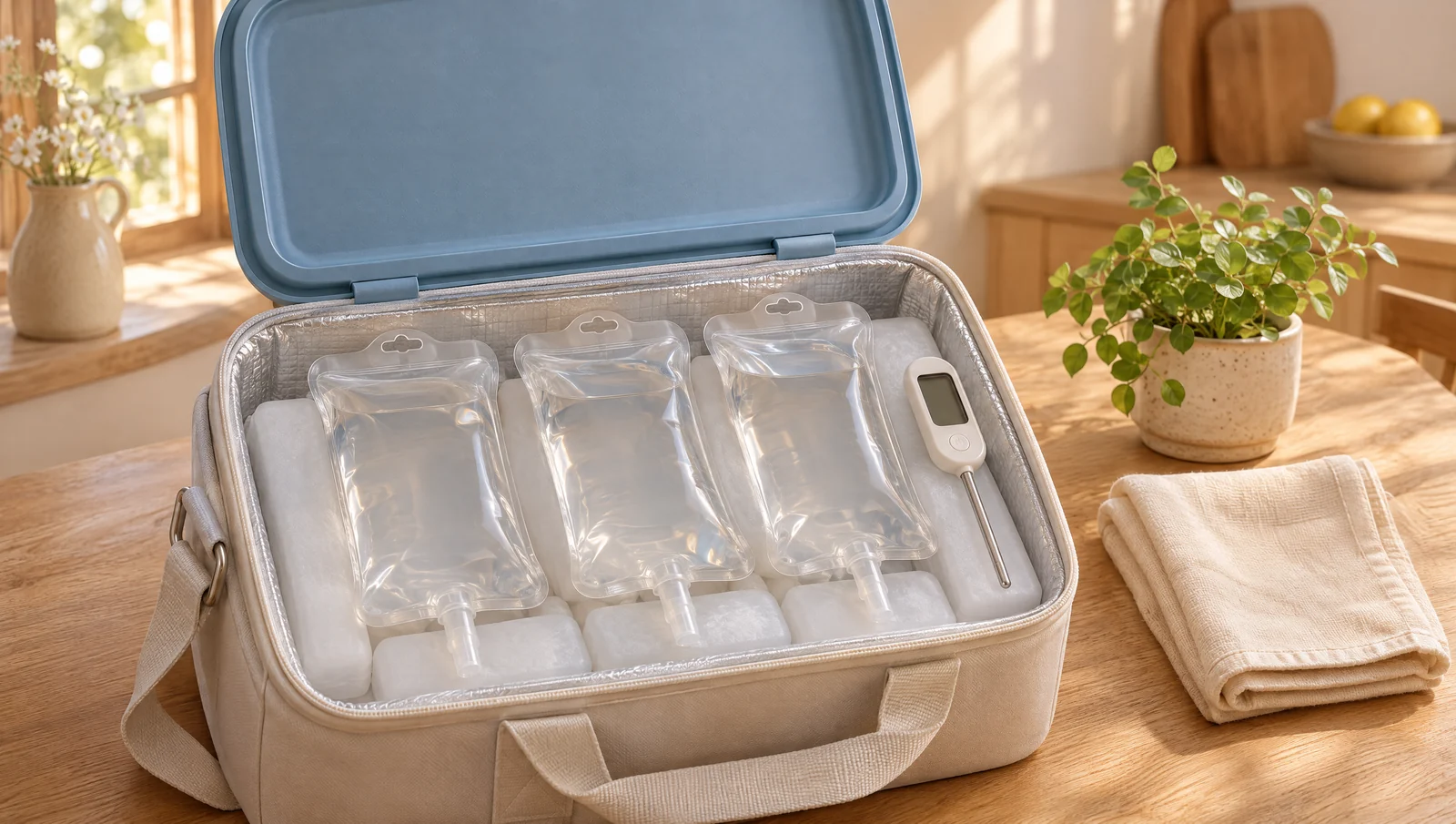
A storefront can argue about its prep area. A mobile nurse has a kitchen table. That makes preparation the weakest point of most mobile businesses, and the rule everyone reaches for is “immediate use”.
The immediate-use provision sits in USP General Chapter 797, the national standard for sterile compounding. The revised chapter, official since 1 November 2023, lengthened the window for administration from one hour to four, for preparations of no more than three sterile components (DJ Holt Law). Many mobile operators treat that as permission to mix at the bedside.
The boards that have written about IV clinics read it more narrowly, and they do not read it identically.
- Kentucky. A joint statement from the state’s boards says adding vitamins to an IV bag is compounding, and that a treatment prepared under a lawful prescription may be prepared for immediate use, meaning administration within four hours (Kentucky joint statement).
- Wisconsin. The state’s interdisciplinary guidance says use of the immediate-use provision “does not circumvent USP sterile compounding requirements”, and lists conditions including written procedures and aseptic technique (Wisconsin DSPS).
- North Carolina. The Board of Pharmacy’s guidance treats a place that compounds intravenous drug products as a pharmacy that must hold a permit, and describes the immediate-use provision as intended for situations of immediate need (North Carolina Board of Pharmacy).
- California. The nursing board’s position, above, is that the nurse may not do the mixing at all.
So the same act, a nurse drawing two vials into a bag at a client’s table, is described as acceptable within four hours in one state, conditional in another, a pharmacy activity in a third and outside the nurse’s scope in a fourth. Three things follow for a mobile operator.
Ask the pharmacy board, not only the nursing board. The nursing board answers what the nurse may do. The pharmacy board answers whether the preparation is lawful.
Never mix ahead. Whatever a state allows, the immediate-use provision is not a basis for preparing the day’s bags at home in the morning. That is batch compounding without a pharmacy.
Consider not mixing. Patient-specific bags from a pharmacy, or stock from a 503B outsourcing facility, move the preparation to someone licensed and equipped for it. It costs more per bag and removes the question.
The vehicle: a mobile IV van, or the car you already own

There are two different businesses hiding in the phrase “mobile IV”.
The visiting nurse. A clinician drives to the client and treats them in their home, hotel or office. The vehicle is transport and storage. An ordinary car can do it, and most solo operators start this way.
The mobile clinic. A fitted van or bus in which clients are treated. This is closer to a storefront on wheels, and it is the model most likely to meet facility rules, as in Florida’s mobile clinic definition. A fitted mobile IV van also brings commercial vehicle questions about weight, driver licensing and inspection that a car does not.
Whichever you run, the vehicle has three jobs.
- Hold temperature. Fluids and additives have labelled storage ranges, and a parked car in summer or winter is outside most of them within minutes. That means insulated or powered storage, a thermometer you can read, and a rule about what happens to stock after an excursion. Follow each product’s labelling and your supplier’s instructions.
- Stay locked and unremarkable. Prescription drugs in a vehicle are a theft risk and a diversion risk. Carry the day’s stock, not the month’s.
- Stay ordered. A nurse who has to search a boot for a pressure cuff has already lost time she may need.
On branding, a wrapped van is marketing and costs more to insure. It is a later decision, not a launch requirement.
Sharps and waste when there is no back room
Every visit produces used sharps and contaminated material in a place that has no way to deal with them, so they come home with you.
The federal baseline is OSHA’s Bloodborne Pathogens Standard, 29 CFR 1910.1030, which applies to any employer whose staff may be exposed and requires a written exposure control plan and puncture-resistant, closable sharps containers. On top of that, medical waste is regulated state by state, and some states require registration as a generator. The practical choices are a contract with a licensed hauler or a mail-back sharps service.
Two mobile specifics are easy to miss. The container has to be secured in the vehicle, upright and closed, not loose in a bag. And nothing is left at the client’s home, including in their household rubbish.
Emergencies in a living room

Texas named its law after Jenifer Cleveland, who died after an IV given at a med spa. The law that followed is about who orders and who administers, because the failure was one of oversight. A mobile service concentrates the same risk: one clinician, no colleague, and an ambulance that has to find a private address.
A mobile emergency protocol is therefore a different document from a clinic’s. At a minimum it should answer:
- What the nurse carries for an allergic or adverse reaction, as specified by the medical director, and how its expiry dates are checked.
- When the nurse stops and calls 911, written as criteria, not left to judgment in the moment.
- How the prescriber is reached during a visit, and what happens if they cannot be.
- What is recorded afterwards, and who reviews it.
- When a visit is refused: a client who appears intoxicated, a setting with no clean surface, a group where the person who booked is not the person being treated, or anyone whose exam does not match what the nurse finds on arrival.
That last list matters commercially. Events, hotel rooms and morning-after call-outs are where mobile demand is strongest and where the conditions for a safe infusion are weakest. A written right to refuse protects the nurse’s licence and the business.
Mobile IV insurance
Insurance for a mobile service has one job a clinic policy does not: it has to cover care delivered away from any premises you control. Check that in writing before the first visit.
The policies operators describe are consistent:
- Professional liability, for the clinical work, on each clinician and on the entity. A nurse’s own policy is not the business’s policy.
- General liability, for injury or damage at a client’s location that is not a clinical error.
- Commercial auto. A personal auto policy typically excludes business use, which means a crash on the way to a client may not be covered at all.
- Cyber and privacy, if you hold client health information.
- Workers’ compensation, once you employ staff.
Published premium figures come from parties with something to sell, so treat them as a starting range. Veincraft Academy, a training company, puts each of professional liability, general liability and commercial auto in a band of roughly $1,000 to $3,000 a year for a small operator (Veincraft Academy). A marketing agency in the sector, citing an industry association guide, puts professional liability at $500 to $2,500 a year per provider. Hotels and event venues may ask for higher limits and a certificate before they let you in.
One separate question hides in the same search. Clients ask whether mobile IV is covered by their health insurance. Elective hydration and vitamin infusions are generally sold as cash-pay services, and a business that starts billing insurers changes its regulatory position in several states, Florida among them.
What a mobile IV business costs to start
The published ranges disagree by a factor of ten, which tells you they describe different businesses.
| Source | Who they are | Startup range | What it describes |
|---|---|---|---|
| OMG Marketing | Marketing agency | $10,000 to $30,000 | A solo operator using an existing car |
| Veincraft Academy | Training company | $11,000 to $50,000 | Lean launch through to a small team |
| CIA Medical | Medical supplier | $50,000 to $100,000 | A fuller mobile operation |
The lower figures assume a nurse-owner who is also the only clinician and who already owns the vehicle. The higher ones assume a fitted van, hired nurses and a marketing budget.
Three recurring costs decide whether the business works, and they are the ones startup ranges tend to understate.
The medical director. The marketing agency above quotes $500 to $2,000 a month for a mobile service. Figures for fractional directors in adjacent settings run from $1,500 to $6,000. A quote at the bottom of either range is a question about what the director will actually do, and in Georgia and California the way the director is paid is itself regulated.
The exam for each new client. If a prescriber evaluates every new client before the first infusion, that is a cost per client, and it rises with the growth you want.
Travel. A clinic nurse can treat several clients an hour. A mobile nurse treats one, and then drives. Veincraft reports session prices of $99 to $299, and the number of visits a nurse can complete in a day, not the price, is the constraint on revenue.
A mobile IV franchise, or your own name
A franchise sells a brand, a booking system, supplier relationships and, usually, an arrangement for medical oversight. The marketing agency cited above puts franchise entry at $80,000 to $250,000, against $10,000 to $30,000 for an independent solo launch.
What a franchise cannot sell you is the answer to your state’s questions. The entity that delivers the medical service still has to be owned by whoever your state allows, the prescriber still has to be licensed where your clients are, and the nursing board’s view of your licence does not change with the logo. Before signing, ask a franchisor three things in writing: who owns the clinical entity in your state, who the prescriber is and how they are paid, and where the bags are prepared.
What tends to go wrong
The patterns in the main article all apply. These are the ones specific to mobile.
Bags mixed in advance. Prepared at home in the morning and carried all day. No reading of the immediate-use rules supports it.
The one-nurse model in a state that questions it. Georgia’s medical board has named it. Other boards may.
Stock in a hot car. No thermometer, no excursion rule, and no record.
A personal auto policy. Discovered to exclude business use after the first accident.
Group bookings. One person books for six, the exam covers one, and the nurse is under social pressure in a hotel suite.
Sharps in a tote bag. Or left behind.
The business question underneath
Mobile solves the rent and creates a ceiling. One nurse, one client and a drive between each visit means revenue grows only by adding nurses and vehicles, while the prescriber and the director remain fixed costs carried by a single service.
The operators who get past that ceiling do it by putting more through the relationship they already have. The client who books a monthly drip is already asking about weight, energy and recovery, and those are questions for a prescriber, not a bag.
Where we sit
Clinic Healthcare is a Local Healthcare program, and what it does is narrow on purpose: it lets a practice add medical weight management without becoming the prescriber. How it works names every party and what each one does.
The clinician is Arora Health, an independent physician-led medical group licensed in all fifty states. They evaluate the client, they decide whether treatment is appropriate, and not everyone qualifies. Local Healthcare provides the platform. We do not practise medicine, do not make prescribing decisions and do not decide who is a candidate. Compounded medications are prepared by state licensed pharmacies, are not FDA approved, and we make no claim that any compounded preparation is as safe or as effective as any branded alternative.
To be clear about what this is not: it is not a medical director for your IV service, it does not supply or prepare IV bags, and it does not answer the ownership, order, preparation or scope questions above for your mobile business. Those stay yours. It is a separate program with its own clinicians, for a different treatment.
On pricing, the Local Healthcare platform fee is $50 per treatment per month. Medication and fulfilment are billed at cost and quoted directly, because pharmacy product pricing varies by product, strength and pharmacy, and any figure printed here would be wrong for most partners.
The partner sells the program to their client and takes payment as merchant of record through its own account; Local Healthcare manages the platform for the partner and never handles the money; the clinician is independent.
Any figures shown are illustrative, not a promise of income. What a partner earns depends on the retail price it sets, its patient volume and retention. The partnership agreement is the controlling document.
Availability varies by state.
How current this is
Checked on 13 November 2026 against: Jackson Walker and Hendershot Cowart on Texas House Bill 3749; the Georgia Composite Medical Board position statement, revised August 2026; Jones Health Law on Florida mobile clinics, an article last updated in 2023; the California Board of Registered Nursing’s March 2026 board materials; the Kentucky joint statement on IV hydration clinics; the Wisconsin interdisciplinary guidance on IV hydration therapy; the North Carolina Board of Pharmacy’s guidance on walk-in IV therapy clinics, updated January 2024; DJ Holt Law on the 2023 revision of USP General Chapter 797; OSHA’s Bloodborne Pathogens Standard, 29 CFR 1910.1030; and Veincraft Academy, OMG Marketing and CIA Medical for published cost and premium ranges, each of which sells into this market and is labelled as such in the text.
This article is general information. It is not legal advice, it is not medical advice, and it has not been reviewed by outside counsel or by a clinician. The boards quoted above describe their own states, they do not agree with each other on preparation at the point of care, and several of these positions are less than a year old. Confirm anything you intend to rely on with your own boards of nursing and pharmacy and your own counsel, and check the date above before treating any of it as current.